Lenny's Podcast PM tactics in 60 seconds. Stripe, Airbnb, Figma insights. Read the key frameworks, watch later. Updated weekly.

28 AI-powered summaries • Last updated Mar 8, 2026

This page tracks all new videos from Lenny's Podcast and provides AI-generated summaries with key insights and actionable tactics. Get email notifications when Lenny's Podcast posts new content. Read the summary in under 60 seconds, see what you'll learn, then decide if you want to watch the full video. New videos appear here within hours of being published.

Latest Summary

The most successful AI company you’ve never heard of | Qasar Younis

1:24:243 min read81 min saved

Key Takeaways

About Applied Intuition and Qasar Younis

  • Applied Intuition is a $15 billion, under-the-radar AI company that adds AI to vehicles like cars, tractors, planes, and submarines.
  • 18 of the top 20 automakers are customers, along with major construction, mining, trucking companies, and the Department of Defense.
  • Qasar Younis, co-founder and CEO, grew up on a farm in Pakistan and started his career as an engineer at GM and Bosch.

Vision for AI's Impact

  • AI is poised to bring about an "industrial revolution" of benefits, similar to the past, leading to broader access to healthcare, goods, and services.
  • Net human suffering should decrease significantly due to AI advancements.
  • Physical AI will bring autonomy to industries like farming, mining, and construction, which are facing labor shortages due to an aging workforce.
  • AI can democratize access to mobility, making self-driving cars accessible to everyone, potentially freeing people from disabilities and poverty.

Addressing AI Anxiety

  • The root of fear surrounding AI is misunderstanding; learning about its limitations can alleviate anxiety.
  • Videos of advanced robots (like nunchuck-wielding ones) can be misleading, often representing pre-programmed machinery rather than sentient beings.
  • The anxiety around robots in entertainment is often greater than for robots in familiar industrial settings (like car factories) because the underlying technology is less understood.
  • The true impact of technological shifts, like the advent of AI, can be both positive and negative, but society can guide its development for good.
  • Investors' reactions to AI stocks are often driven by market speculation and misunderstanding of the technology's long-term viability, not necessarily societal fear.

The Future of Physical AI and Robotics

  • AI will be integrated into existing physical systems, rather than necessarily leading to humanoid robots taking over all tasks immediately.
  • Self-driving cars are already significantly safer than human drivers and will become more ubiquitous, reducing injuries and deaths.
  • The impact of AI will be profound in industries like farming, mining, construction, and trucking, addressing labor shortages and improving safety.
  • While humanoid robots are visually striking, the more immediate and pragmatic impact of AI will be in enhancing existing machines and vehicles.
  • The evolution of AI in vehicles is similar to the progression of mobile technology, with advanced capabilities emerging rapidly once enabling hardware and infrastructure are in place.

Applied Intuition's Philosophy and Values

  • Applied Intuition's core values are "radical pragmatism" and "our best work is done alone and quietly," inspired by companies like Berkshire Hathaway.
  • Qasar's philosophy, influenced by his background, emphasizes focusing on product and customers over public promotion, especially for early-stage companies.
  • Key company values include speed, never disappointing the customer, technical mastery, high output, and "laugh a lot" for perspective and grounding.
  • "Half the work is follow-up" is another crucial operating principle, highlighting the importance of execution.
  • The company emphasizes a "cleaning zen" where everyone participates in maintaining the workspace, fostering a sense of shared responsibility and attention to detail.
  • Applied Intuition has operated without spending raised capital, a testament to its efficient and pragmatic approach.

Advice for Founders and Leadership

  • Successful companies tend to show traction early; founders struggling after two years should consider if the core foundation (co-founders, market, or personal commitment) needs resetting.
  • Founding a company is a craft that improves with practice; the first few years should be viewed as a learning process, not necessarily an immediate success.
  • Founders should be humble, learn from diverse experiences (including working in large organizations), and seek out perspectives beyond their immediate industry.
  • It's crucial to encourage dissent and diverse viewpoints within a company to ensure the best ideas surface and that the company doesn't lose its way due to momentum or a fixed vision.
  • Leaders should strive to make decisions based on rational analysis rather than emotion, focusing on the objective best course of action and then managing the human element.
  • Founders must be right; the ultimate evidence of success is a sustainable, standalone business, not just a vision or rapid fundraising.
  • Taste in leadership is developed through broad life experiences and the ability to discern good ideas and judgment, not just technical expertise.

More Lenny's Podcast Summaries

28 total videos
The design process is dead. Here’s what’s replacing it. | Jenny Wen (head of design at Claude)1:17:25

The design process is dead. Here’s what’s replacing it. | Jenny Wen (head of design at Claude)

·1:17:25·73 min saved

The Design Process is Dead The traditional design process, once treated as gospel, is now considered dead due to the rapid pace of engineering enabled by AI. Designers no longer have the time for extensive mockups; the focus has shifted. The Evolving Role of Designers A significant part of a designer's role is now supporting engineers and teams in execution, rather than just handing over designs. Mocking and prototyping now constitute a smaller portion (30-40%) of a designer's work, down from 60-70% previously. The remaining time is spent collaborating closely with engineers, providing feedback, and even implementing polished features ("last mile" work). Design visions are now shorter-term (3-6 months) and often take the form of prototypes guiding direction rather than elaborate decks. Human brains remain valuable for making final decisions, establishing accountability, and discerning what truly matters. AI's Impact on Design Workflow Engineering advancements, like the ability to spin up multiple agents quickly, are forcing design processes to adapt. AI tools like Claude Code assist in idea generation and can even help with execution. The non-deterministic nature of AI models makes traditional mockups less effective; real-world testing with actual users is crucial. Designers are increasingly working within the AI stack, using tools like Claude Chat, Claude Co-work, and Claude Code (integrated with VS Code). Figma remains valuable for exploring diverse options and refining visual/interaction details, as current coding tools are more linear. Maintaining Quality and Trust In a fast-paced environment, launching "research previews" with acknowledged flaws is acceptable if the core value is evident and iteration is promised. Building trust is achieved through speed, responsiveness to feedback, and demonstrating continuous improvement. This approach of rapid iteration and user feedback is crucial for maintaining brand integrity. The Future of Human Value in Design AI will likely improve in areas like taste and judgment, but humans will still be needed to make final decisions and be accountable. The hardest parts of building software often involve human disagreements and decision-making, which AI cannot fully resolve. New Interfaces and Human-AI Interaction A combination of traditional UIs and conversational interfaces (like chatbots and terminals) will persist. Widgets and interactive elements offer efficiency, while chat provides flexibility and infinite ways to interact with models. Conversational interfaces scale well across different levels of intelligence. Management and Team Building Managers need to remain close to the work, potentially through IC rotations, to understand evolving processes and tools. Effective management involves providing direction and people management, creating an environment for the team to do their best work. "Low leverage" tasks for managers can be high leverage if they involve deep product engagement, bug reproduction, or showing care for the team. Psychological safety, fostered by comfort in poking fun and not fearing the leader, is key to high-performing teams, balanced with high standards. Hiring and Key Designer Archetypes Key traits to look for in designers include resilience and adaptability. Valuable archetypes include: Strong Generalists: "Block-shaped" individuals with strong core skills in multiple areas, allowing them to flex across roles. Deep Specialists: Individuals with exceptional expertise in a niche area. Craft New Grads: Humble, eager, and wise early-career individuals with a "blank slate" for learning new approaches. Aspiring designers should build actual things and showcase their work. Learning to use coding tools is beneficial for designers, even if not becoming full-time coders. AI is not yet a "hireable" designer, lacking the nuanced skills of a strong generalist, specialist, or new grad. The Legibility Framework This framework assesses founders and ideas as legible or illegible. Illegible ideas are on the frontier, not yet fully understood, but can be valuable opportunities. Designers can act like VCs internally, identifying and translating illegible ideas through storytelling and UX.

AI is critical for humanity’s survival: Cisco President on the AI revolution | Jeetu Patel1:27:23

AI is critical for humanity’s survival: Cisco President on the AI revolution | Jeetu Patel

·1:27:23·83 min saved

AI's Role in Humanity's Survival AI is critical for humanity’s survival due to declining birth rates and an aging population that will require care. AI can help address the potential for widespread human suffering if there aren't enough people to care for the elderly. AI as a Mega Trend and Transformation at Cisco AI is identified as a mega trend, a foundational movement in human history, not just a hype cycle. Cisco is undergoing a significant transformation to become an AI-forward company. Leaders should prepare for the future by fast-forwarding six months and anticipating upcoming changes. Leadership and Team Dynamics A key principle is to establish enough trust within a team for open critique and debate in public. Stamina and persistence (hunger) are more crucial than intellect for success. Cisco's Role in AI Infrastructure Cisco is a critical infrastructure company for the AI era, addressing constraints in power, compute, and network bandwidth. They provide networking, optics, safety, security, and observability solutions to connect GPUs and data centers. Cisco addresses the trust deficit in AI by ensuring safety and security, and the data gap by facilitating the use of proprietary enterprise and machine data. Transforming Cisco into an AI-First Company Innovation is a choice; companies can choose to be creative and innovative regardless of size. Cisco committed to being AI-first, going "all in" rather than hedging, and aligning individual success with AI adoption. The company shifted from a conglomerate of acquisitions to a platform company with tightly integrated products that work seamlessly together. Cisco operates in an open ecosystem, comfortable partnering with competitors to serve customer success. The Concept of "Permission to Play" and "Right to Win" Companies must have permission to play in a market and a clear route to market to achieve mass distribution. Focusing efforts on areas where Cisco has a natural advantage and logical entry points (like networking GPUs) yields better returns. Cisco avoids consumer tech because they lack the necessary distribution channels and "permission to play." Lessons on Leadership and Communication Don't delegate storytelling; leaders must be the custodians of the company's message to avoid lossiness. Maintain the intensity of the message from top to bottom, treating employees as adults and being direct. Clarity of thought leads to clarity of communication; emphasize the "why" behind initiatives. Praise in public, criticize in private is a flawed model; directness in public and building trust in private is more effective. Infrastructure work doesn't always get glory but can receive blame; focus on ecosystem success and customer outcomes. Building Great Companies: A Six-Part Framework The framework, in descending order of importance, includes: Timing, Market, Team, Product, Brand, and Distribution. Timing is paramount; a great product or team can fail if the market timing is wrong. A large enough market, captured in manageable chunks, is crucial. A well-rounded team that complements each other's weaknesses is essential. Product is the soul of the company, and a mediocre product is unethical. Brand, once lost, is very difficult to resurrect. Distribution is key because "if you build it, they will not come." Navigating Trends and Future Preparedness Differentiate between mega trends (like AI) and hype cycles (like Web3, which was hard to understand). Leaders must anticipate future states (e.g., AI in 6 months) and not be biased by current assumptions or over-reliance on experience. Inexperience can bring fresh ideas; companies need a combination of experience and inexperience to innovate. Key Takeaways and Advice Stamina trumps intellect; hunger, curiosity, and persistence are teachable/learnable, but hunger is innate. Business is a team sport; solving hard, important problems attracts the best talent. Be prepared to learn and unlearn; don't be intellectually lazy. The platform you choose and the quality of problems you solve determine your path. Don't be stingy with words; express appreciation and love explicitly. Be useful, as Arnold Schwarzenegger advises. Pay it forward and help the next person.

Head of Claude Code: What happens after coding is solved | Boris Cherny1:27:45

Head of Claude Code: What happens after coding is solved | Boris Cherny

·1:27:45·82 min saved

Claude Code's Impact and Future 100% of Boris Cherny's code is AI-generated, with no manual edits since November. He ships 10-30 pull requests daily. Productivity per engineer has increased 200% due to AI tools like Claude Code. The speaker predicts that coding is largely solved and in a year or two, learning to code may not be as critical. The future vision is a world where everyone can program and build software easily. Claude Code's growth is accelerating, with daily active users doubling monthly. The initial hackathon project, Claude Code, has transformed software engineering and is expanding to other functions. Claude Code is now estimated to be responsible for 4% of all GitHub commits, with predictions of reaching 20% by year-end. Senior engineers, including Boris, are no longer writing code manually. The Genesis and Evolution of Claude Code Claude Code started as a "little hack" on the Anthropic Labs team, alongside other projects like MCP and the desktop app, following a trajectory of coding, then tool use, then computer use. The initial Claude Code prototype, ClaudeCLI, demonstrated the model's ability to figure out how to use tools (like a batch tool) to answer questions without explicit instructions. The terminal-based interface was chosen for ease of development initially, and its ability to keep up with rapid model improvements. Despite a slow initial external reception, Claude Code's daily active users grew rapidly once users understood its potential. The principle of "latent demand", where users find surprising or unintended uses for a tool, was key to Claude Code's success. Claude Code's success led to its integration into various platforms like iOS, Android, desktop apps, IDE extensions, Slack, and GitHub. User feedback has been crucial for Claude Code's continuous improvement and development. The Shifting Landscape of Software Engineering Predictions from a year ago about AI writing 100% of code are now becoming reality. Boris predicted in May 2025 that an IDE might not be necessary by year-end, a prediction that was met with surprise but proved accurate for his personal workflow by November. The exponential growth of AI capabilities, a core belief at Anthropic (evidenced by co-founders' work on scaling laws), suggests continued rapid advancement. Innovation requires psychological safety for experimentation, with an acceptance that many ideas may not succeed. Boris emphasizes the importance of pulling on a thread when you feel you're onto something, even if it's not immediately obvious. Boris now writes 100% of his code using Claude Code and has not edited a line manually since November. While code is AI-generated, human review is still necessary for correctness and safety, with Claude also performing automatic code reviews. The Next Frontier Beyond Coding Claude is evolving to be more proactive, analyzing feedback, bug reports, and telemetry to suggest bug fixes and new features, acting more like a "co-worker." Coding is considered "largely solved" for many types of programming. The focus is shifting to adjacent areas and general tasks that can be automated, with Claude used for tasks like paying bills and project management. Claude Code and Co-work are being used to analyze feedback channels like Slack threads to identify actionable insights. AI's ability to improve rapidly means that gains made through specific scaffolding or fine-tuning can be quickly surpassed by more general, capable models. Productivity, Innovation, and AI at Anthropic Engineering productivity has seen a 200% increase with Claude Code, a gain considered "insane" compared to previous industry improvements of a few percentage points. The rapid pace of AI advancement has normalized unprecedented change in tech. Users need to adapt to newer models, as skills and approaches developed for older versions may become outdated. A key principle is to let AI handle tasks, as demonstrated by a newer engineer using Claude Code to debug a memory leak more effectively than Boris. The advice to "underfund things a little bit" at the start encourages teams to rely on AI and find efficient solutions. Encouraging speed and allowing individuals to ship quickly is paramount, with AI as a tool to achieve this. When building AI products, it's recommended to give engineers unlimited tokens for experimentation, optimizing for cost later. Some engineers are spending hundreds of thousands of dollars a month on tokens, indicating significant AI usage. The Changing Nature of Programming and AI Adoption Programming has historically evolved from hardware to software, and now to AI-driven generation. Boris doesn't worry about his own skills atrophying, viewing programming as a continuum of evolving tools. The historical analogy of the printing press is used to describe the democratizing and transformative potential of AI in programming. The shift is from writing code to describing desired outcomes to AI. Boris views programming as a practical tool for building things, not an end in itself, though acknowledges some enjoy the art of coding. AI is expected to impact roles adjacent to engineering, such as product management, design, and data science, and eventually any computer-based work. The term "agent" refers to an AI that can use tools and act in the world, not just converse. Concerns about AI's impact on jobs are acknowledged, but the focus is on increased enjoyment and productivity for many. Building and Using AI Products Key advice for building AI products includes not boxing in the model, providing tools and goals, and letting the AI figure out the execution. The "bitter lesson" suggests betting on more general models over highly specific or fine-tuned ones, as general models tend to outperform in the long run. Building for the model six months in the future, rather than the current model, is a strategy for long-term product success. Assumptions for future models include improved tool use, longer execution times, and greater autonomy. For using Claude Code: use the most capable model (Opus 4.6) with "maximum effort" enabled, as it can be more token-efficient. "Plan mode", which prevents immediate code generation and allows for interactive planning, is highly recommended. Experimenting with different interfaces (terminal, desktop app, mobile, Slack) is encouraged. Competition in the coding agent space is seen as beneficial for driving innovation. Anthropic's approach prioritizes user feedback and building a good product over closely monitoring competitors. Safety, Research, and the Future of AI Anthropic's work involves studying AI safety at three levels: alignment/mechanistic interpretability (internal model workings), evals (laboratory settings), and real-world behavior. Mechanistic interpretability aims to understand the specific functions of neurons within AI models. Early release of products like Claude Code is partly for studying their real-world safety and behavior. Anthropic open-sources research and tools (like the Claude Code sandbox) to promote safe AI development across the industry ("race to the top"). Anxiety about agents not working is acknowledged, but Boris mitigates this by running multiple agents concurrently. The speaker is from Odessa, Ukraine, and shares a personal connection with the interviewer, also born in Odessa. Boris's future plans post-AGI include making miso, a long-term, patient process that contrasts with rapid AI development. The core belief at Anthropic is that AI development progresses through coding, tool use, and computer use, which is key to understanding safety. Despite rapid growth, AI adoption is still considered early (1% done).

How to be a CEO when AI breaks all the old playbooks | Sequoia CEO Coach Brian Halligan1:14:37

How to be a CEO when AI breaks all the old playbooks | Sequoia CEO Coach Brian Halligan

·1:14:37·74 min saved

It is difficult to provide a summary without access to the YouTube video content. Please provide the transcript or a description of the video's content. Once you provide the necessary information, I can summarize it for you in HTML format using h4 and ul/li tags, keeping it under 4000 characters.

“Engineers are becoming sorcerers” | The future of software development with OpenAI's Sherwin Wu1:19:40

“Engineers are becoming sorcerers” | The future of software development with OpenAI's Sherwin Wu

·1:19:40·76 min saved

The Evolving Role of Engineers with AI 95% of OpenAI engineers use Codex daily, and 100% of pull requests (PRs) are reviewed by Codex, with humans taking a final look. Engineers using Codex open 70% more PRs, and this gap is widening as they become more proficient. The job of an engineer is transforming from writing code to managing "fleets and fleets of agents," akin to a "sorcerer" casting spells. The metaphor of engineers as wizards from the book "SICP" (Structure and Interpretation of Computer Programs) is becoming a reality, where programming languages are "incantations." The current state is like "the sorcerer's apprentice," where AI offers high leverage but requires skill and seniority to steer, as models can "go off the rails." Challenges and Best Practices with AI Agents A team at OpenAI maintains a 100% Codex-written codebase, facing challenges when agents don't perform as expected without a human "escape hatch." Often, an agent's failure stems from insufficient or underspecified context/information, requiring better documentation and encoding tribal knowledge into the codebase. Codex significantly speeds up code reviews, turning 10-15 minute tasks into 2-3 minutes, with many small PRs trusted solely to Codex. The general CI process and post-push/deployment are heavily automated by Codex, collapsing work for engineers and enabling more frequent merges and pushes. OpenAI dogfoods its own models for reviews but uses internal model variants for different perspectives. Impact on Engineering Management AI has less changed the role of managers than engineers, but trends suggest shifts. AI tools empower top performers, widening the productivity spread within teams; managers should spend even more time unblocking and supporting them. Managers can use tools like ChatGPT (hooked to internal knowledge) for tasks like performance reviews, potentially allowing them to manage much larger teams (e.g., more than the current 6-8 direct reports). The management philosophy of acting like a surgeon's support team (from "The Mythical Man-Month") is becoming more relevant, with managers "looking around corners" to unblock engineers. An open insight was the potential for AI to anticipate and identify future blockers for engineers/teams. Unforeseen Second and Third-Order Effects of AI The concept of a "one-person billion-dollar startup" implies massively increased individual leverage. This will lead to a "huge startup boom" of smaller businesses (e.g., 100 small startups enabling one large one), creating a "golden age of B2B SaaS." Instead of being limited by support costs, a single person could outsource specialized needs to other "one-person startups" offering tailored software (e.g., support software for podcasters). The VC ecosystem may change, with a proliferation of smaller, highly profitable companies (e.g., "tens of thousands of $10 million startups") that are not traditional "venture scale." Distribution becomes increasingly important as the number of products and services grows exponentially. AI Deployment ROI and Customer Feedback Many AI deployments likely have negative ROI, partly due to a disconnect between Silicon Valley's "bubble" understanding and the basic needs of most users. Successful AI deployments require both top-down executive buy-in and bottom-up adoption and evangelization from actual employees. Companies should consider forming an internal "tiger team" of technical but non-engineer enthusiasts to explore AI capabilities, share knowledge, and foster excitement. Listening to customers isn't always the right strategy in AI because the models change so quickly they "eat your scaffolding for breakfast." The advice is to "build for where the models are going, not where they are today," anticipating future capabilities rather than optimizing for current limitations. Future of OpenAI's API and AI Trends In the next 12-18 months, models are expected to perform multi-hour coherent tasks (currently multi-hour 50% of the time, 80% for under an hour), leading to different product designs. Significant improvements are expected in multimodal models, especially audio, which is seen as an underrated domain for enterprise and business processes. There's an underestimated opportunity in "business process automation," applying AI to repeatable, deterministic operations in non-tech industries. OpenAI views itself as an "ecosystem platform company" committed to fostering external builders, releasing all models to the API, and maintaining neutrality to fulfill its mission of spreading AI's benefits to all humanity. The API offers various layers of abstraction, from low-level "responses API" for custom agent building to the "agents SDK" for orchestrating swarms of agents, and "agent kit" for UI components, plus "eval products" for testing. Advice for Navigating the AI Era The next 2-3 years will be an exciting and transformative period in tech; people should "not take it for granted" and engage with the technology. To avoid "missing the boat," individuals should lean in, learn, build tools, and use AI tools to understand their capabilities and limitations as they improve. Don't get overwhelmed by the "noise" of constant news; start small by engaging with one or two tools (e.g., Codex client, ChatGPT with internal data) to gain familiarity. Startups should focus on building something customers "really love" rather than overly stressing about OpenAI (or other large labs) potentially "squashing" their idea, as the market is vast.

The rise of the professional vibe coder (a new AI-era job)1:42:31

The rise of the professional vibe coder (a new AI-era job)

·1:42:31·97 min saved

Introduction to Vibe Coding: A New AI-Era Job Lazar Yavanovich is the first official Vibe Coding Engineer at Lovable, a dream job involving full-time vibe coding. The role focuses on bringing ideas to life fast, with quality and security, by building internal and external products across various departments. Examples include building Shopify integration templates, Lovable's merch store, and internal tools like feature adoption metrics. Lazar often chooses to build custom solutions himself, as it can be faster than setting up pre-existing enterprise accounts. He thrives on taking rough concepts and ideas and quickly making them a reality. The Vibe Coder's Advantage and Mindset Lazar highlights his non-technical background as an advantage, having never written a line of code. Non-technical individuals, unaware of traditional limitations, successfully prompt AI to build complex things (e.g., Chrome extensions, desktop apps, videos) deemed impossible by technical peers. A core mindset is the "positive delusion" that everything is possible until proven wrong. The primary skill required is clarity in articulating requests to the AI. The Aladdin and the Genie analogy illustrates this: vague wishes (like "be taller") lead to undesired outcomes because AI lacks human context. Today, 100% of one's time should be optimized for good judgment, clarity, and quality taste. Lazar believes coding will become like calligraphy—a rare art, not a widespread necessity for building. Strategies for Clarity and Pre-Building Planning Vibe coders should dedicate 80% of their time to planning and chatting, and only 20% to execution, prioritizing clarity over raw output speed. AI tools should be treated as technical co-founders and educators, fostering learning during the building process. It's crucial to religiously read the agent output, focusing on the AI's explanations and reasoning rather than just the code itself. Understand LLM limitations: the context memory window (token limit) and AI's inability to comprehend human nuance (e.g., "you know what I mean?"). To enhance clarity, cultivate good judgment, taste, and an understanding of "world-class" design through extensive "exposure time" to high-quality examples. Lazar's Parallel Building Workflow for initial clarity: Start by providing a "brain dump" prompt (e.g., using voice dictation). Initiate a new project with more specific clarity on features and pages. Find and attach reference designs from platforms like Mobin or Dribble. Provide actual code snippets (HTML/CSS) for desired design or functionality, as AI interprets code best for pixel-perfect results. This parallel approach offers multiple design options, clarifies ideas, and ultimately saves time and credits by quickly identifying the optimal direction. Productivity Hack: Build 5-6 projects simultaneously, switching between tabs. Maintaining Context and Structuring Projects Once a winning design is selected, dedicate significant time (e.g., a full day) to planning and documentation. Utilize AI (or custom GPTs) to generate Project Requirements Documents (PRDs): Master Plan (.md): A high-level overview of the app's intent and target audience, referencing other PRDs. Implementation Plan (.md): A high-level roadmap outlining the order of building (e.g., backend first, then authentication). Design Guidelines (.md): Detailed descriptions of the app's look and feel, potentially including CSS elements for precise direction. User Journeys (.md): High-level outlines of how users interact with the app and its features. Tasks.md: A granular list of tasks and subtasks for the AI to execute, derived from the PRDs. Define AI behavior using "rules.md" or "agent.md" (e.g., "read all files before acting," "execute the next task and report on testing"). With these structures in place, prompts become simple: "proceed with the next task," as the AI now has dynamic, delegated context. Regularly update these documents to adapt the AI's token window and keep its context fresh, which is crucial for preventing "AI sloppiness" and saving resources. Debugging and Unblocking with the 4x4 Framework Even with thorough planning, problems will occur; Lazar uses a "4x4 framework" for debugging: Tool's "Try to fix" feature: For minor issues, the AI can often self-correct. Add console logs for awareness: If the AI is unaware of a problem, ask it to write debugging console logs in relevant files. Then, copy the output into the chat for the AI to analyze and fix. Use external diagnostic tools: Export the codebase to GitHub, then use tools like OpenAI's CodeX or upload to Claude/ChatGPT for diagnostic insights. Lazar uses these for diagnosis, not direct code changes, due to familiarity. Revert and re-prompt: Acknowledge that most problems stem from unclear prompts. Revert to an earlier version (using built-in version control), take a break, and re-prompt with clearer instructions. After fixing an issue, engage the agent in a "post-fix learning loop": Ask, "How could I have prompted you better to solve this immediately?" Incorporate these learnings into the rules.md to continually improve future interactions. AI is highly obedient and agreeable; unclear or frustrated inputs can lead it to "lie" about fixes or waste tokens on apologies, diverting from the actual problem-solving. The Future of Work and Essential Skills AI acts as an amplifier; without clear direction, it merely "produces garbage faster." The gap between "good enough" (easily achieved with AI) and "world-class/magic" output has widened, making the latter the new focus. Product Managers are currently "winning" in the AI era due to their emphasis on clarity and judgment. Designers are poised to be the next "winners," as AI currently struggles with emotional and aesthetic decision-making. Focus on developing exquisite design skills, understanding diverse design styles, and learning to prompt for them effectively. Elite engineers will remain critical for maintaining, scaling, and building the underlying infrastructure that supports billions of AI builders. However, for application-layer product building, traditional roles (engineer, designer, PM) are converging. Coding itself will become a niche, artistic skill, like calligraphy, as AI handles most code generation. The primary interaction layer above code will be the agent conversation and the AI's internal thinking processes. AI is rapidly integrating many manual workflows, making previous "hacks" obsolete, which signals the fast pace of evolution. Future valuable skills include emotional intelligence, understanding human nature, and tackling non-deterministic problems. Great design, compelling copywriting, and raw human experiences will be highly valued as AI-generated content proliferates. Average writers face competition, while elite writers will be amplified. Comedians, whose work relies on nuanced human understanding, are predicted to remain indispensable. Becoming a Professional Vibe Coder Lazar's diverse background (forestry engineering, blue-collar jobs, community management) highlights that the path to vibe coding is non-linear. Key to his success was building in public and sharing knowledge, through platforms like YouTube and LinkedIn, showcasing failures and projects. He encourages participating in hackathons and connecting with other builders. For job applications, some candidates creatively send Lovable apps instead of traditional resumes to demonstrate their skills. The core advice: "hire yourself first" by doing the job you would have done anyway. Many companies are already hiring for Vibe Coder-like roles or listing "Lovable skills" in job descriptions. The transition from a consumer to a builder, enabled by tools like Lovable, can transform fear into excitement. He advises starting to build "good enough" projects and then using exposure time and learning (e.g., reading agent output, following top designers) to elevate to "magic." Tech stack is irrelevant; stellar user experience, quality, taste, and design are paramount. Lazar invites listeners to join Lovable's team if they resonate with the mission and energy, aiming to empower everyone to build.

A child psychologist’s guide to working with difficult adults | Dr. Becky Kennedy1:31:57

A child psychologist’s guide to working with difficult adults | Dr. Becky Kennedy

·1:31:57·91 min saved

• The core value of this video lies in **Intellectual Novelty**, as Dr. Becky Kennedy offers a framework for understanding and interacting with difficult adults by applying principles from child psychology. • Adults, much like children, often exhibit challenging behaviors because they lack the necessary skills to manage their internal states; understanding this allows for more effective communication and problem-solving. • The "power of repair" is crucial in relationships; it involves taking responsibility for missteps, acknowledging their impact, and communicating a commitment to do better, which rebuilds trust and fosters cooperation. • The concept of "connecting before correcting" emphasizes understanding and validating another person's reality and perspective before addressing their behavior, creating a bridge for cooperation. • The framework of "Good Inside" involves separating behavior from identity, recognizing that even when behavior is problematic, the person's core goodness remains, which is key to productive conversations and behavior change. • The "most generous interpretation" (MGI) is a tool to reframe negative perceptions of others' behavior by considering their underlying needs or challenges, leading to more empathetic and effective interventions. • Being a "sturdy leader" involves acknowledging and validating others' emotional experiences without being overwhelmed by them, allowing for clear decision-making and guiding the group through difficulties. • Effective boundaries are defined as what you commit to doing, requiring no action from the other person, distinguishing them from requests and empowering the boundary-setter. • The philosophy of "resilience over happiness" suggests that optimizing for short-term happiness can lead to adult anxiety and fragility, whereas navigating difficulties builds the coping skills necessary for long-term well-being and happiness. • The "I believe you" and "I believe in you" framework is essential for supporting individuals through struggles; acknowledging their current experience while expressing confidence in their future capability helps them overcome challenges. • Applying workplace learning principles, such as providing constructive feedback early and often, is vital for building resilient work cultures and preventing fragility, even if it causes temporary discomfort. • A key actionable takeaway is asking children (or colleagues) for feedback on how you could be a better parent/leader, using the "If I could do one thing differently this week to be a better [parent/leader] to you, what would it be?" question.

Marc Andreessen: The real AI boom hasn’t even started yet1:44:36

Marc Andreessen: The real AI boom hasn’t even started yet

·1:44:36·101 min saved

The Historic Moment and AI's Impact • We are living in a very historic time (2025-2026 are exceptionally interesting), characterized by a collapse of trust in legacy institutions, a "liberated" global conversation, and massive geopolitical shifts. • AI is the "philosopher's stone," transforming "sand into thought"—the most common thing into the most rare and valuable. • AI has proven its ability to perform reasoning and problem-solving in critical domains like medicine, science, and law, with AI coding now surpassing even the world's best programmers. • The impact of AI is not fully understood because it's hitting an environment of very slow technological change (low productivity growth for 50 years) and declining global population growth. • We need AI to boost productivity and fill jobs that a shrinking human population won't be able to do, making its timing "miraculously well." • AI will prevent the economy from shrinking due to depopulation, ensuring human workers remain at a premium, not a discount. • Even if AI triples productivity, it only brings us back to 1870-1930 levels of job churn, an era perceived as having abundant opportunity and new careers. • A dramatic increase in productivity from AI would lead to a massive economic boom and collapsing prices, effectively giving everyone a "giant raise" and making a social safety net much easier to fund, dispelling dystopian "everyone's poor" scenarios. AI's Impact on Individuals and Education • AI will make people who are good at things "very good", and truly great individuals "spectacularly great", fostering "super-empowered individuals." • Parents should encourage their children to become "super-empowered individuals" by fully leveraging AI in their chosen fields. • The concept of "agency" (initiative, willingness to act) is crucial in an AI-powered world, contrasting with a society often focused on rule-following. • The ideal way to educate a child (at n=1) is through one-on-one tutoring, which AI can now make economically feasible for a much broader population (e.g., Khan Academy, Alpha school model). • AI can serve as an "ultimate lever" for children with agency to become primary contributors in various fields, from physics to art. • For children, understanding and leveraging AI is paramount; the notion that Silicon Valley parents shield their kids from computers is largely a misconception. • The concern about AI causing job loss is "reductive"; focus on "task loss" and task changing, as jobs are bundles of tasks that evolve with technology (e.g., secretaries and executives adapting to email). AI's Impact on Specific Roles and Career Development • A "Mexican standoff" exists between product managers, engineers, and designers, where each believes AI allows them to do the others' jobs; this is "all kind of correct." • AI is already good at coding, designing, and product management tasks. • The opportunity lies in becoming a "super-powered individual" by harnessing AI to excel in one's primary role and gain proficiency in the other two. • This leads to a "T-shaped" or "E-shaped" career strategy: be very deep in one domain (e.g., coding) and proficient enough in others (e.g., design, product management) to leverage AI tools. • This creates "super relevant specialists" who are "triple threats," capable of building and designing new products from scratch. • The skill of "taste and design" (Capital D design) will become even more valuable, as AI handles lower-level design tasks, freeing humans to focus on higher-level conceptual and human-centric design. • Learning to code is still a valuable skill; deep understanding of code is necessary to effectively orchestrate, debug, and understand the output of AI coding bots. • AI is an incredible teaching tool: spend "every spare hour" talking to AI to "train me up," asking it to teach new skills, give problems, and evaluate results. • Learn by watching AI "think" and make decisions and by asking it what could have been done differently when stuck (e.g., LLM councils). AI's Impact on Founders and Industry Structure • Leading AI-forward founders are exploring three layers of impact: 1) AI redefining products (e.g., Nano Banana generating images vs. Photoshop editing), 2) AI changing jobs (e.g., 10 super-empowered coders instead of 100 traditional ones), and 3) AI changing the definition of a company itself. • The "holy grail" of a one-person billion-dollar company, where a founder oversees an "army of AI bots," might become feasible for software. • There's no clear answer yet on "moats" in AI; the field is a "complex adaptive system" with many unknowns. • Despite the massive investment and expertise in large AI labs, capabilities often become commoditized and replicated quickly (e.g., open-source GPT-3 equivalents emerged fast). • The value might shift from foundational models (LLMs) to AI applications ("wrappers") that adapt models for specific domains and human needs (e.g., Claude Code, Co-work). • Pre-judging the long-term structural outcomes of AI (e.g., industry structure, big winners, killer apps) is "really, really dangerous" due to the rapid pace of change and numerous unpredictable factors (politics, regulation, human choice). Marc Andreessen's Media and Product Diet • His media diet follows a "barbell strategy": either up-to-the-minute information (X) or timeless old books, with skepticism towards everything in the middle (newspapers, magazines). • He emphasizes direct exposure to practitioners (via podcasts, newsletters like Substack) as a highly underrated source of insight. • He's fascinated by AI voice technologies (e.g., Grok with Bad Rudy, Sesame's voice experiences) and voice input wearables (e.g., Meta glasses, Whisper Flow for transcription). • His 10-year-old son is "100% obsessed" with Replet and "vibe coding" (e.g., building Star Trek Next Generation LCARS simulators). • He recommends the movie "Edington" (set in a small New Mexico town during 2020, grappling with COVID, BLM, and AI through the lens of internet experience) as the best movie of the decade. • He recommends A16Z's YouTube channel and Py McCormack's piece on A16Z for insights into their work and thinking.

5 questions to ask when your product stops growing | Jason Cohen (2x unicorn founder)1:46:04

5 questions to ask when your product stops growing | Jason Cohen (2x unicorn founder)

·1:46:04·105 min saved

• When product growth stalls, start by diagnosing customer churn (logo churn), as this is the most critical indicator of fundamental product dissatisfaction and acts as a hard cap on potential growth. • The commonly cited reason of "too expensive" for cancellations is often a superficial excuse; dig deeper to uncover the real, underlying issue, such as a lack of integration or unfulfilled core promise, by asking "What made you cancel?" instead of "Why did you cancel?". • To combat churn, focus on early customer engagement and onboarding, as improving this initial experience can have a disproportionately large impact on long-term retention and profitability. • Assess pricing not just by the number, but by its structure and positioning; by framing the value proposition around company growth rather than cost savings, you can command significantly higher prices and attract a more suitable market segment. • Existing customers' growth (Net Revenue Retention - NRR) is crucial for sustainable growth, as it directly counteracts churn; aim for NRR significantly above 100% to scale effectively, as simple upgrades may not fully compensate for percentage-based churn. • When marketing channels become saturated or begin to decline (the "elephant curve"), explore creative new channels, such as partnerships with agencies or building ecosystems, or consider developing new products rather than relying solely on optimizing existing efforts. • The final question to ask when growth stalls is whether growth itself is still the primary objective, as some companies may find greater success and fulfillment by focusing on profitability or stasis, especially if further growth is culturally misaligned or requires serving undesirable customer segments.

How a Meta PM ships products without ever writing code | Zevi Arnovitz1:15:13

How a Meta PM ships products without ever writing code | Zevi Arnovitz

·1:15:13·74 min saved

• Zevi Arnovitz, a non-technical Product Manager at Meta, demonstrates how to ship products without writing code by leveraging AI tools like Cursor and Claude. • He emphasizes a structured workflow using AI-powered "slash commands" within Cursor, which include steps like "create issue," "exploration phase," "create plan," "execute plan," "review," "peer review," and "update docs." • Arnovitz advocates for a gradual approach to learning AI tools, starting with simpler platforms like ChatGPT projects for context and gradually moving to more powerful tools like Cursor for complex development. • He highlights the importance of AI-powered code review by having models like Claude and Codex review each other's code, acting as a "dev lead" to catch errors and improve code quality. • Arnovitz suggests that AI significantly democratizes building products, enabling individuals with no technical background to create functional applications and startups, and he encourages others to embrace AI as a tool for learning and creation. • He shares his "learning opportunity" slash command, designed to help users understand complex technical concepts by priming AI to explain them using the 80/20 rule, fostering a "10x learner" mindset.

How to show up in any room with a low heart rate: Silicon Valley’s missing etiquette playbook1:26:36

How to show up in any room with a low heart rate: Silicon Valley’s missing etiquette playbook

·1:26:36·86 min saved

• The core of etiquette is building trust and projecting genuine confidence, maintaining an abundance mindset, remembering your worth, and keeping your heart rate low. • Key etiquette tips include being early (but not excessively so), offering a firm handshake, repeating names back to people, making eye contact, and introducing partners. • When navigating conversations, be inclusive, balance asking questions with sharing information (like a ping-pong game), match vocabulary where appropriate, and aim to leave people wanting more. • For dining, avoid ordering the most expensive items, always offer to pay (and expect to be declined), tip generously (20-30% or more is suggested), and remember the "B for bread, D for drinks" hand placement rule. • In virtual meetings, always have your camera on, dress appropriately, and ensure your background is tidy (e.g., close your closet door, make your bed). • When scheduling, the less senior or busy person should offer flexibility, avoid defaulting to scheduling links like Calendly, and always be mindful of time zones and reasonable meeting times.

Why most AI products fail: Lessons from 50+ AI deployments at OpenAI, Google & Amazon1:26:23

Why most AI products fail: Lessons from 50+ AI deployments at OpenAI, Google & Amazon

·1:26:23·85 min saved

• Building AI products fundamentally differs from traditional software due to non-determinism (unpredictable user behavior and LLM responses) and the agency-control trade-off (giving AI more autonomy means relinquishing human control). • Successful AI product development requires a "problem-first" approach, focusing on the core user problem rather than getting lost in complex AI solutions, and necessitates starting with low agency and high human control, gradually increasing AI autonomy as confidence builds. • Key success factors for AI product development include strong leadership (hands-on engagement, willingness to unlearn intuitions), an empowering culture (focus on augmentation, not replacement), and technical progress driven by deep workflow understanding and rapid iteration cycles, not just the latest AI models. • "Pain is the new moat"; companies that successfully navigate the iterative, often difficult, process of building and refining AI products gain a competitive advantage through the hard-won knowledge and experience acquired. • The next year of AI will likely see the rise of more capable background and proactive agents that deeply understand user workflows and context, moving beyond current limitations of not being plugged into the right places where work actually happens. • Multimodal AI experiences, combining language, vision, and other sensory inputs, are poised for significant advancement, bringing AI closer to human-like conversational richness and enabling the extraction of value from previously inaccessible data like handwritten documents.

The high-growth handbook: Molly Graham’s frameworks for leading through chaos, change, and scale1:31:57

The high-growth handbook: Molly Graham’s frameworks for leading through chaos, change, and scale

·1:31:57·91 min saved

• The core principle of "giving away your Legos" means continuously learning and delegating what you've mastered to move onto new challenges, a concept crucial for leaders in rapidly scaling companies. • Embrace the "J curve" career path of taking significant risks and falling for a period, as this often leads to growth far beyond traditional, linear career progression ("stairs"). • The "waterline model" suggests that team problems are most often rooted in structural issues (goals, roles, expectations) or team dynamics, rather than interpersonal or intrapersonal conflicts; leaders should "snorkel before they scuba" by addressing the top levels first. • Effective goal-setting involves adhering to a few key rules: no more than three company goals, one goal must "win" in priority, goals must be easily understandable ("explain it like I'm five"), strategy should "hurt" (implying painful trade-offs), one goal requires one owner, and goals alone are insufficient without a process for follow-up and accountability. • Key rules of thumb for leading through change include recognizing that a leader's role is to find answers, not necessarily have them all; avoiding promises about things outside of your control; understanding that rapid hiring (more than doubling headcount annually) leads to chaos and duplication; and prioritizing the business's needs over individual people's immediate comfort. • A founder's personality defines approximately 80% of a company's culture, making the leader's role to articulate and extend that existing culture rather than to fundamentally change it.

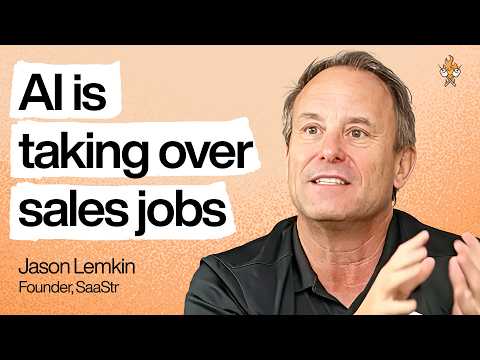
We replaced our sales team with 20 AI agents—here’s what happened next | Jason Lemkin (SaaStr)1:42:11

We replaced our sales team with 20 AI agents—here’s what happened next | Jason Lemkin (SaaStr)

·1:42:11·101 min saved

• SaaStr replaced a sales team of 8-9 humans with 1.2 humans (a Chief AI Officer part-time) and 20 AI agents, achieving similar business performance with increased efficiency and scalability. • AI is displacing "midpack and mediocre" sales performers, while augmenting top performers, and email-based SDR roles are expected to be 90% displaced by AI within a year. • To effectively implement AI agents, individuals must actively train and iterate on them, rather than expecting them to work optimally out-of-the-box, as this hands-on approach is crucial for ROI. • The key to successful AI agent adoption in Go-To-Market (GTM) is selecting vendors that provide strong support (e.g., Forward Deployed Engineers) and actively engaging in the training and data ingestion process. • High-quality AI-generated outbound emails are achieved by training agents on top-performing human sales copy and personalizing messages using available data, and recipients generally do not care if the communication is AI-generated as long as it adds value. • The future of sales and GTM will demand increased efficiency and productivity from humans, requiring a proactive embrace of AI tools, with roles like SDRs and inbound qualifiers being largely automated.

“I deliberately understaff every project” | Leadership lessons from Rippling’s $16B journey1:36:17

“I deliberately understaff every project” | Leadership lessons from Rippling’s $16B journey

·1:36:17·95 min saved

• Rippling deliberately understaffs every project to avoid politics and prevent people from working on lower-priority tasks, which is seen as "poison" that wastes time and creates "crust." • Extraordinary results demand extraordinary effort, and leaders should remind their teams that being in a comfort zone at work is a mistake, as high-intensity effort is necessary for exceptional outcomes. • When making decisions like staffing or deadlines, executives should make their best guess and then manage to that guess, learning and adjusting as they go, rather than aiming for perfect foresight. • The framework of "alpha" (outperformance) and "beta" (volatility) is used to assess people and processes: high alpha, low beta is ideal, and processes are designed to lower beta at the cost of potentially suppressing alpha. • Founders should be wary of the Silicon Valley mantra to "never quit," as it is often self-serving for venture capitalists, and it's sometimes better to quit, reset, and pursue product-market fit with a clean slate. • Rippling aims to be the most successful business software platform in history by focusing on the "people primitive" – the core of every workflow concerning who is doing what, who owns it, and who is accountable. • The concept of entropy, the tendency of systems toward disorder, requires constant energy injection to combat decay and maintain intensity, especially in a competitive market where any relaxation allows competitors to gain an advantage. • Feedback and escalations are viewed as gifts that help identify and solve problems, crucial for improving processes and systems, and leaders should not be "chill" but intensely focused on driving outcomes.

Why securing AI is harder than anyone expected and the coming security crisis | Sander Schulhoff1:32:41

Why securing AI is harder than anyone expected and the coming security crisis | Sander Schulhoff

·1:32:41·92 min saved

• AI guardrails, a common defense against prompt injection and jailbreaking, are "terribly insecure" and do not work because the attack space is virtually infinite and guardrails are easily bypassed, even by humans within an hour. • The AI security industry is oversold, with many companies offering automated red teaming (which is too easy to implement and always finds vulnerabilities) and guardrails (which are ineffective), leading to a potential market correction. • Unlike classical cybersecurity where bugs can be patched, AI systems have a "brain" that cannot be reliably fixed, meaning even if 99.99% of issues are addressed, the remaining vulnerabilities persist. • The primary reason mass AI attacks haven't occurred is the early stage of adoption and limited capabilities of AI agents, not because the systems are secure. • For companies deploying AI, focus on traditional cybersecurity best practices for permissioning and data access (like the CAMEL framework) rather than ineffective AI-specific guardrails, especially for "read-only" conversational chatbots. • The intersection of classical cybersecurity and AI security, particularly in areas like proper permissioning and understanding AI's unique vulnerabilities, represents the critical frontier for future security roles.

The new AI growth playbook for 2026 | How Lovable hit $200M ARR in one year1:31:56

The new AI growth playbook for 2026 | How Lovable hit $200M ARR in one year

·1:31:56·91 min saved

• Lovable achieved over $200 million in Annual Recurring Revenue (ARR) within its first year, a remarkable growth rate attributed to a strategic shift from optimization to innovation in their growth playbook. • The company prioritizes "building in public" through employee and founder social media engagement, and a strategy of giving away their product extensively to remove barriers to entry and generate word-of-mouth. • Lovable's growth is driven by a reinvention of solutions rather than optimization, with the growth team spending 95% of their time innovating on new growth loops and features, such as Shopify integrations and voice mode, rather than refining existing user journeys. • Activation is deeply embedded within Lovable's core product and AI agent team, rather than being solely the responsibility of the growth team, allowing for rapid iteration and improvement of the initial user experience. • A key growth lever is "building in public," which involves frequent shipping of new features and constant communication about them, creating market noise, driving re-engagement, and fostering a sense of product dynamism and responsiveness to user feedback. • The core of Lovable's success lies in creating a "minimum lovable product" and ensuring every interaction is delightful, shifting the focus from mere utility to human-centric experiences that users want to share. • Giving the product away for free, especially in the AI space where interaction costs exist, is a deliberate "growth secret sauce" to remove monetization friction, drive exploration, and allow users to experience the "wow moment" and become advocates. • Product-market fit is no longer a static achievement but an ongoing, rapid cycle of recapture (every 3 months) due to the fast-evolving AI technology and consumer expectations, forcing companies to constantly reinvent and re-validate their offering. • For AI companies, a successful hiring strategy involves prioritizing passionate individuals with high agency and autonomy who can convert chaos into clarity, including AI-native new graduates and even failed startup founders. • The "She Builds" initiative, offering women-only hackathons with unlimited product access, aims to bridge the gender gap in AI adoption by empowering women to build hyper-local, relevant solutions and increase diversity in software creation.

Why humans are AI's biggest bottleneck (and what's coming in 2026) | Alexander Embiricos (OpenAI)1:25:13

Why humans are AI's biggest bottleneck (and what's coming in 2026) | Alexander Embiricos (OpenAI)

·1:25:13·84 min saved

• The current underappreciated limiting factor to AI's acceleration is human typing speed and multitasking speed, specifically for prompting AI and manually validating its generated work, especially during code review. • Starting in 2026 (next year relative to the recording), early adopters will experience a "hockey stick" in productivity with AI agents, followed by larger companies in subsequent years; this flow of increased productivity back into AI labs will mark the arrival of the AGI tier. • OpenAI's Codex is designed to evolve beyond a coding tool into a proactive "software engineering teammate" that participates in ideation, planning, validation, and maintenance, with the belief that writing code is the most effective way for any intelligent agent to use a computer. • Codex has seen explosive growth, increasing 20x since August and now serving trillions of tokens weekly, enabling significant acceleration in development, such as building the Sora Android app from scratch to public launch in 28 days with only 2-3 engineers. • Effective AI agent development requires a holistic approach, integrating the model, API, and harness to create capabilities like "compaction" for long-running tasks, aiming for "helpful by default" systems that reduce reliance on constant human prompting. • To effectively use Codex, developers should give it their hardest, real-world tasks (e.g., complex bugs), first allowing it to understand the codebase and formulate a plan to build trust before delegating more extensive work.

The $1B Al company training ChatGPT, Claude & Gemini on the path to responsible AGI | Edwin Chen1:10:32

The $1B Al company training ChatGPT, Claude & Gemini on the path to responsible AGI | Edwin Chen

·1:10:32·70 min saved

• Surge AI, a bootstrapped company with fewer than 100 employees, achieved over $1 billion in revenue in under four years by focusing on exceptionally high-quality data for training AI models, rejecting the typical Silicon Valley fundraising and growth-hacking models. • The core of Surge AI's success lies in its deep understanding and sophisticated measurement of data quality, going beyond simple checkboxes to capture nuanced aspects like creativity, emotional impact, and surprise, akin to distinguishing between basic poetry and Nobel Prize-winning work. • Edwin Chen, founder of Surge AI, critiques the AI industry's focus on easily gamifiable benchmarks and engagement metrics (like LM Arena leaderboards) which he believes incentivize "AI slop" and dopamine-chasing over genuine truth and advancing humanity, contrasting it with Anthropic's more principled approach. • Chen advocates for companies to define and optimize for complex "dream objective functions" that align with advancing humanity, rather than simplistic proxies that merely maximize engagement or chase superficial metrics, emphasizing that the company's own values shape its AI models. • He posits that true AI advancement and AGI will likely require new learning paradigms beyond current LLMs, emphasizing the need for models to learn in a multitude of ways, similar to human learning, and highlights the growing importance of Reinforcement Learning (RL) environments for simulating real-world complexity and teaching end-to-end task completion.

The end of product managers? Why LinkedIn is turning PMs into AI-powered “full stack builders”1:07:32

The end of product managers? Why LinkedIn is turning PMs into AI-powered “full stack builders”

·1:07:32·67 min saved

• LinkedIn is implementing an AI-powered "full stack builder" model to empower individuals to take products from idea to market, regardless of their traditional role, enabling faster adaptation to rapid technological change. • The core idea is to automate tasks outside of five key builder traits: vision, empathy, communication, creativity, and judgment, with a particular emphasis on judgment and decision-making in complex situations. • LinkedIn is re-architecting its platform and building custom internal AI tools and "agents" (e.g., trust, growth, research, analyst agents) tailored to its unique data and processes, as off-the-shelf solutions often require significant customization. • The shift to full-stack builders requires a significant cultural change management effort, including redefining performance expectations, celebrating wins, and encouraging a growth mindset, rather than just providing new tools. • Top performers are currently leveraging AI tools most effectively, demonstrating a tendency to continuously improve their craft and stay at the cutting edge, highlighting the importance of incentivizing adoption for broader organizational success.

What world-class GTM looks like in 2026 | Jeanne DeWitt Grosser (Vercel, Stripe, Google)1:26:02

What world-class GTM looks like in 2026 | Jeanne DeWitt Grosser (Vercel, Stripe, Google)

·1:26:02·85 min saved

• The core of world-class Go-To-Market (GTM) in 2026 involves treating GTM functions holistically, much like a product lifecycle, integrating marketing, sales, customer success, and support to create a cohesive customer journey. • A significant evolution in GTM is the rise of the "Go-To-Market Engineer," a role that leverages technical prowess and AI to re-architect workflows, automate tasks like personalized outreach at scale, and significantly increase seller efficiency, aiming to free up salespeople to spend more time interacting with customers. • Effective GTM in 2026 requires a shift in sales focus from solely problem-solving to emphasizing competitive differentiation and helping customers avoid risk, as 80% of buyers are motivated by risk reduction rather than solely pursuing upside. • Segmentation is critical, moving beyond simple size (small, medium, large) to incorporate dimensions like growth potential, business model, traffic volume (e.g., CRUX rank), and workload type to create targeted content and sales approaches. • Treating GTM as a product involves designing a customer buying journey that feels personalized, human, and unique, adding value at every touchpoint, even with non-buyers, to foster long-term relationships and build credibility.

A guide to difficult conversations, building high-trust teams, and designing a life you love1:45:20

A guide to difficult conversations, building high-trust teams, and designing a life you love

·1:45:20·104 min saved

• Most technical leaders assume they must have all the answers, but coaching unlocks brilliance in the team. • Two coaching skills: Active listening (global listening, hearing beneath the words) and asking powerful questions using the GROW model (Goals, Reality, Options, Way forward). • Burnout can be avoided by designing life to spend ~80% of time in your gifts/strengths. • For co-founders to build great relationships: self-awareness, commitment (co-founder "vows"), and dedicated time to connect and address issues. • Framework for difficult conversations: Observe, Feelings, Needs, Request – aim for mutual understanding, not convincing the other person they're wrong.

Mental models for building products people love ft. Stewart Butterfield1:30:36

Mental models for building products people love ft. Stewart Butterfield

·1:30:36·90 min saved

• Stuart Butterfield (Flickr, Slack founder) shares product and leadership wisdom. • Utility Curves: Initial effort yields little value, then a steep rise, then diminishing returns. Invest enough to reach the steep value increase. • Taste: Can be developed, creates advantage, as most don't invest in it; Tilt your umbrella: Be considerate, empathic. • Friction vs. Comprehension: Focus on making things *simple* and preventing users from having to think; don't just reduce clicks. • Pivoting: Be coldly rational, exhaust good ideas, and create distance for intellectual decisions.

The Godmother of AI on jobs, robots & why world models are next | Dr. Fei-Fei Li

The Godmother of AI on jobs, robots & why world models are next | Dr. Fei-Fei Li

• The video features Dr. Fei-Fei Li, known as the "Godmother of AI," discussing the history, present, and future impact of artificial intelligence. • AI's impact on humanity: It's a net positive that enhances lives, but its trajectory depends on responsible development and use by individuals and society. • ImageNet's pivotal role: Overlooked ingredient of bringing AI to life is big data; combined with neural networks and GPUs, it sparked modern AI, revolutionizing object recognition and machine learning. • World Models (Marble): A new frontier involving spatial intelligence, allowing users to create, interact with, and reason within 3D worlds, with applications in robotics, gaming, creativity, and design. • Advice for young people in AI: Intellectual fearlessness is key; focus on passion, mission alignment, and potential impact rather than getting caught up in the competitive landscape.

“Dumbest idea I’ve heard” to $100M ARR: Inside the rise of Gamma | Grant Lee (co-founder)

“Dumbest idea I’ve heard” to $100M ARR: Inside the rise of Gamma | Grant Lee (co-founder)

• Gamma, an AI-powered presentation and website design tool, reached $100M ARR in 2 years. • Influencer Marketing: Onboard influencers manually, ensuring they understand the product and can tell the story in their voice; focus on micro-influencers within specific echo chambers/niches. • Founder Marketing: Share learnings/insights on social media, adapt the tone for different platforms (LinkedIn vs. Twitter), and invest in copywriting skills. • Prototype Testing: Test early prototypes with platforms like Voice Panel or UserTesting.com to gather rapid feedback. • GPT Wrapper Strategy: Go deep into a specific workflow, combine multiple models, understand customer needs, and solve the problem, not just chase the technology.

$1M to $10M: The enterprise sales playbook with Jen Abel1:21:36

$1M to $10M: The enterprise sales playbook with Jen Abel

·1:21:36·81 min saved

• The "mid-market" is a false construct; companies should focus on either small business (marketing-led) or enterprise (sales-led) as they are distinct games with different hiring and sales strategies. • When selling to enterprise leaders, focus on "vision casting" and selling opportunities (the "Mario on Blast" future state) rather than specific problems, as this resonates with their need to innovate and stay ahead. • Aim for higher Average Contract Value (ACV) deals, ideally starting between $75K-$150K, rather than discounting heavily for smaller deals ($10K), which can create a false sense of product-market fit and hinder future growth. • To gain enterprise traction, consider offering services initially, as enterprises understand and readily purchase services, which can be a "back door" to introduce and eventually transition them to your product. • Enterprise sales is an "art" focused on "deal crafting" and building strong relationships, requiring salespeople who can "cosplay a founder" by selling the vision and future value, not just the product's features. • Avoid using generic AI outbound tools that pull from the same databases; instead, focus on manual, personalized outreach, leveraging insights from platforms like LinkedIn and even sending emails on weekends to stand out and build trust.

She turned 100+ rejections into a $42B company | Melanie Perkins1:06:10

She turned 100+ rejections into a $42B company | Melanie Perkins

·1:06:10·65 min saved

• Melanie Perkins faced over 100 investor rejections before founding Canva, a company now valued at $42 billion, by believing in her "Column B" vision—working backward from a dream future rather than just present capabilities. • Canva's success is attributed to a "chaos to clarity" process where every idea starts amorphous and is refined through incremental steps, often visualized in pitch decks and project vision decks. • A core value at Canva is "crazy big goals," which are ambitious, important visions that make individuals feel inadequate, thus motivating hard work to bring them into existence, such as empowering the world to design anything, anywhere, on any device. • Canva's "two-step plan" is to first build one of the world's most valuable companies and second, to do the most good, integrating philanthropy (like donating 30% of equity) as a core driver, not an afterthought. • Despite a two-year period of not shipping new product during a critical codebase rewrite, Canva's team maintained morale through gamified progress tracking and found that overcoming such challenges was essential for future scalability and innovation. • The company actively solicits and acts on community feedback, processing over a million requests annually and closing over 200 "loops" (implementing requested features), including significant products like spreadsheets and AI tools.

About Lenny's Podcast

Lenny Rachitsky interviews world-class product managers, growth experts, and founders to uncover tactical advice on building, launching, and scaling products. Each episode features actionable frameworks from leaders at companies like Airbnb, Stripe, and Figma.

Key Topics Covered

Product managementGrowth tacticsUser researchProduct-led growthCareer development

Frequently Asked Questions

How often does Lenny's Podcast release new episodes?

Lenny's Podcast publishes 2 episodes per week (Wednesday and Sunday) featuring product managers and growth leaders from top tech companies. TubeScout summaries extract key frameworks and tactics so you can identify which PM advice applies to your product stage.

Are these official Lenny's Podcast summaries?

No, these are summaries by TubeScout designed to help product managers extract frameworks and growth tactics from 60-90 minute interviews. Not affiliated with Lenny Rachitsky. Listen to full episodes for complete PM stories and context.

Can I get Lenny's Podcast summaries in my email?

Yes! Add Lenny's Podcast to your TubeScout channels to receive daily digests with summaries of new episodes covering product strategy, growth experiments, user research methods, and PM career advice. Start with a 7-day free trial.

What product management topics does Lenny cover?

Lenny interviews experts on product-market fit, growth loops, user onboarding, pricing strategy, product-led growth, roadmap prioritization, and PM career paths. Summaries highlight specific frameworks, metrics, and tactical advice from leaders at Airbnb, Stripe, and Figma.

Do summaries include the guest's specific frameworks?

Yes, summaries extract key product frameworks, growth tactics, and decision-making processes each guest shares. Each summary identifies actionable frameworks you can implement, though full episodes provide detailed examples and edge cases from the guest's experience.